Disconnected Vendors
Billing and credentialing operated independently without sharing provider information.
And why the revenue you're losing isn't showing up on any report they send you.
Category
Medical Billing
Reading Time
6 min
Location
Las Vegas, Nevada
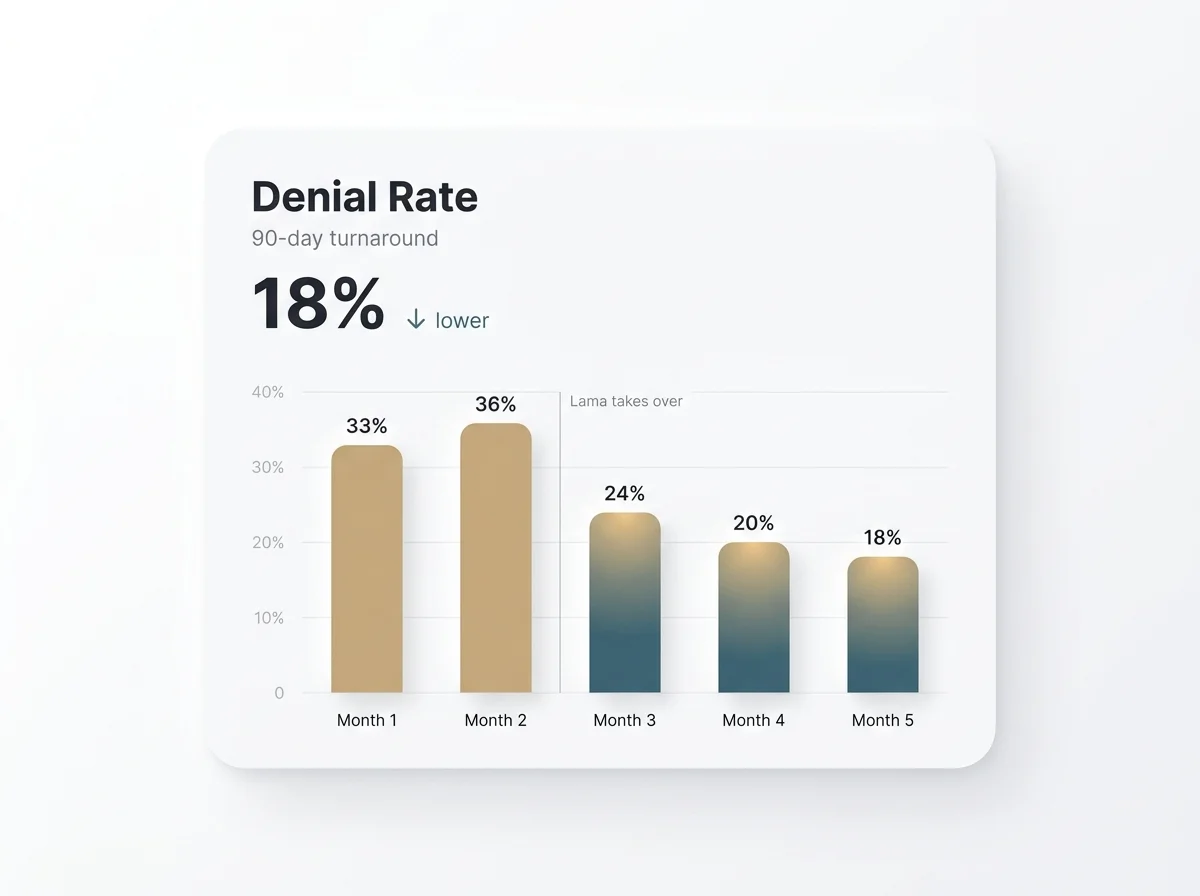
Every case study follows a predictable pattern. A challenge appeared, the underlying cause was uncovered, a solution was implemented, and measurable operational improvements followed.
A successful independent medical practice had worked with the same billing vendor for more than two years. Monthly reports appeared healthy, and nothing suggested a major operational issue.
Revenue continued to leak through recurring claim denials that no one could explain. The billing vendor treated each denial individually instead of identifying the underlying pattern.
Lama Healthcare audited the complete revenue cycle, connected billing with credentialing, corrected provider enrollment discrepancies, and introduced an accountable communication process.
Within ninety days the denial rate dropped significantly because the root cause was removed rather than repeatedly appealed.
Every month the practice received billing reports showing submitted claims, payments received and denials being worked.
Nothing suggested that thousands of dollars were quietly disappearing every month.
The real issue wasn't poor billing. It was that nobody owned the entire revenue cycle.

Every major outcome is the result of a sequence of operational decisions. Understanding where things changed is the first step toward preventing it from happening again.
Practice worked with the same billing vendor for more than two years.
Denials slowly increased while monthly reports continued looking acceptable.
Lama Healthcare reviewed billing, credentialing and payer enrollments together.
Providers were enrolled under incorrect taxonomy codes that billing never verified.
Enrollments were corrected and communication between vendors was established.
Recurring denials reduced dramatically because the real problem had been fixed.
The process was.
Billing and credentialing operated independently without sharing provider information.
Providers had been enrolled under specialty codes that didn't match the services billed.
Recurring denials were treated individually instead of identifying a systemic issue.
Nobody owned the handoff between enrollment and claim submission.
Key Insight
Every case study reveals the same pattern. The issue practices notice first is usually just a symptom. The real solution comes from identifying and correcting the operational gap underneath it.
Reviewed billing workflow, credentialing records and payer enrollments together.
Updated taxonomy codes so provider enrollments accurately reflected billed specialties.
Created communication checkpoints before any provider submitted claims.
Implemented denial reviews that escalate recurring issues instead of repeatedly appealing them.
Our Approach
Instead of treating isolated symptoms, we examine the entire operational workflow, identify the underlying failure point, implement sustainable corrections, and introduce verification steps that prevent the issue from recurring.
Framework
Every successful outcome in this case study came from fixing the underlying operational process rather than treating individual symptoms. Once the workflow became reliable, compliance, billing, documentation, and staff confidence naturally improved.
Outcome Summary
Every case study reveals more than a single operational issue. It highlights principles that every independent practice can use to reduce risk, improve efficiency, and build stronger systems.
Key Takeaway
Sustainable improvement comes from building reliable systems, not reacting to isolated problems. The strongest practices are proactive long before issues become visible.
Billing reports only show what happened, not why it happened.
Recurring denials almost always have an operational root cause.
Credentialing and billing cannot operate in isolation.
Someone must own the complete revenue cycle.
Revenue is protected by systems, not assumptions.
The goal is preventing denials, not simply appealing them.
The fix wasn't in the billing workflow. The fix was in the gap between two vendors who had been operating independently in the same practice.
Gain complete visibility into your revenue cycle, reduce denials, improve collections, and keep every dollar accountable through one operational partner.
Explore ServiceWe'll review your revenue cycle, identify where revenue is being lost, and show you exactly what needs attention before it becomes another month's worth of denials.
What Happens Next
No obligation. No generic sales pitch. You'll leave the conversation with a clear understanding of where your operational risks are and what to do next.
Explore more real-world examples of how operational challenges become opportunities for stronger systems, better compliance, and healthier medical practices.